
If necessary, cultivation of up to the top 10 cm for mechanical weeding or seedbed preparation. The tool may be either a drag or disc cultivator.
Knowledge base
Explore our blog posts, our glossary, the events where the Association has been represented and our press coverage in the Knowledge Base.
Cultivation without ploughing, where all tools other than the plough are allowed. Loosener, grubber, combiner, short disc, ploughshares. Common feature is that they work only vertically, loosening, no rotation, possibly minimal mixing. Here too, the aim is to minimise soil disturbance. The appropriate depth of cultivation should be determined by mechanically testing the soil layers, even before each cultivation. The test can be carried out with a spade, a trowel or [...]
Usually 'conventional' ploughing, where the topsoil is turned down to a depth of 15-45 cm. The top aerated (aerobic) soil layer is deposited at the bottom and the bottom anaerobic layer is deposited at the top, or mixed together, thus damaging and destroying the established soil life. The agitated layer loosens, but this is only temporary or often excessive. Meanwhile, below the cultivation depth, a thick, compacted layer, called the ectal [...]
Ferenc Berend - TMG member
Antal Berente - TMG board member
Péter Tamási - TMG member
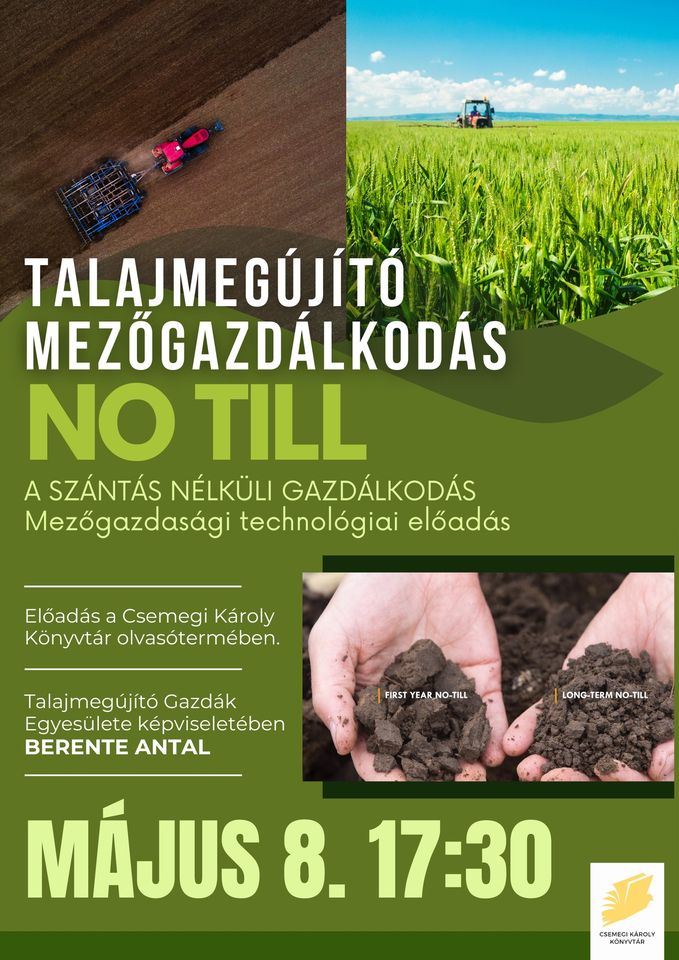
On 8 May, Antal Berente, member of the board of the Soil Renewal Farmers Association, gave a lecture on no-till in the reading room of the Csemegi Károly Library in Csongrád...
Hungarian agriculture has been in compliance with the GMO exemption in the Fundamental Law for twelve years, and last year genetically modified soya had to be imported for animal feed. A...
Attila Szeredi - TMG board member
GY.I.K.
Yes, it is. Even in areas with low rainfall of 250 mm per year, cover crops are successfully grown all over the world. Using various techniques and methods, germination and growth of cover crops can be ensured in such conditions.
Yes, regenerative farming can be applied to all soil types. The methods and practices can be adapted to different soil conditions and are therefore effective in all cases.
Regenerative farming can be used on any scale, from flower pots to thousands of hectares of farmland. The methods and techniques can be adapted regardless of size.
?
Do you have any other questions?
If you can't find the answer you're looking for, please contact us by clicking on the button below and one of our colleagues will be happy to answer your question!

 English
  Magyar
  Deutsch
  Slovenčina
  Українська
  Polski
  Русский
  Slovenščina